
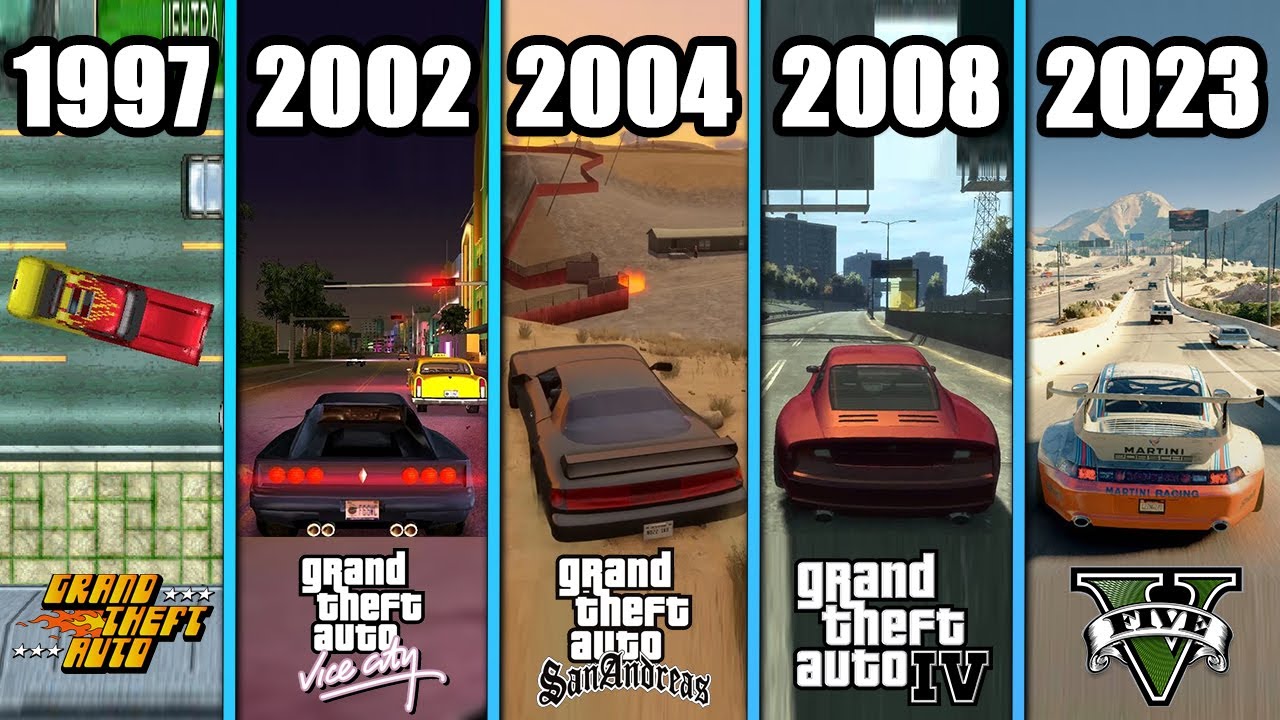

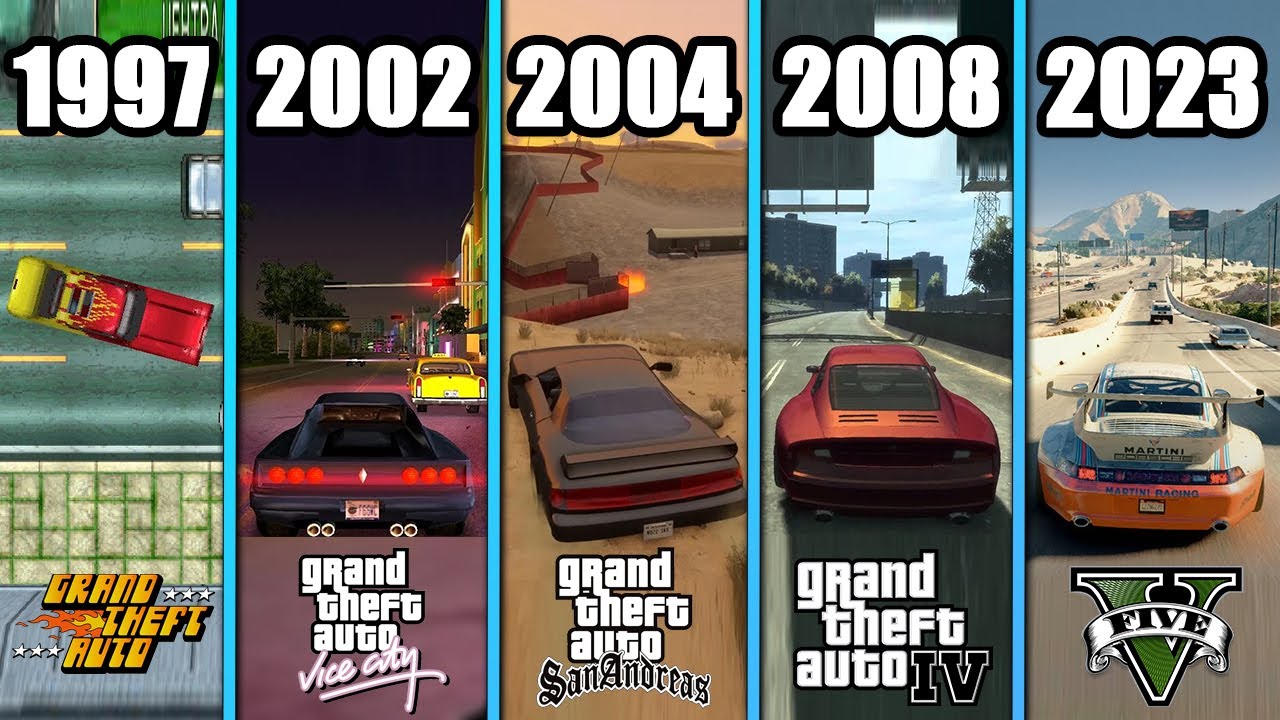
Since its debut in 1997, the Grand Theft Auto (GTA) franchise has become one of the most influential and commercially successful series in the history of video gaming. Known for its open-world design, satirical portrayal of American culture, and innovative gameplay mechanics, GTA has continuously evolved, pushing the boundaries of what games can achieve. This essay explores the journey of GTA from its inception to the present day, examining its technological advancements, narrative depth, societal impact, and ongoing influence on the gaming industry.
The Origins: Grand Theft Auto (1997)
Table of Contents
The franchise’s roots trace back to 1997 when DMA Design (now Rockstar North) released the original Grand Theft Auto. The game was a top-down, 2D open-world crime simulator set across three fictional cities: Liberty City, Vice City, and San Andreas. Players assumed the role of a criminal working their way up the ranks by completing various missions, such as stealing cars, running errands, and engaging in shootouts.
Despite its simple graphics and limited scope by today’s standards, the original GTA was revolutionary for its time. It introduced players to a sandbox environment where freedom of choice was central, a concept that would become a hallmark of the series. Its controversial content—violence, crime, and adult themes—sparked debates about violence in video games, but it also garnered a cult following that appreciated its rebellious spirit.
Transition to 3D and the Breakthrough: GTA III (2001)
The most significant leap in GTA’s evolution came with Grand Theft Auto III in 2001. Moving from 2D to fully three-dimensional graphics, the game set new standards for open-world design and player agency. Set in Liberty City, a fictionalized version of New York City, GTA III introduced a third-person perspective, a more immersive world, and a complex narrative.
GTA III’s success was transformative. It demonstrated that open-world games could tell compelling stories while offering players vast freedom. Its mission structure, character development, and detailed environment created a living city teeming with activity. The game’s voice acting, radio stations, and diverse side activities added layers of realism and immersion.
The game’s success also marked a turning point for Rockstar Games, establishing its reputation as a pioneer of mature, narrative-driven gaming. It became a cultural phenomenon, influencing countless other titles and solidifying GTA’s place in gaming history.
Expanding the Universe: Vice City and San Andreas
Following the success of GTA III, Rockstar released Grand Theft Auto: Vice City (2002), set in a stylized 1980s Miami-inspired city. Vice City introduced a vibrant aesthetic, a memorable soundtrack, and a storyline centering on the rise of a criminal empire amidst neon-lit streets and synth music. It refined gameplay mechanics, added new vehicles, weapons, and side missions, and became renowned for its memorable characters and atmosphere.
In 2004, Grand Theft Auto: San Andreas expanded the franchise’s scope dramatically. Set in a fictional state based on California and Nevada, San Andreas offered a sprawling map with three major cities, rural areas, and mountains. The game introduced RPG elements such as character customization, skill development, and player choices impacting the story.
San Andreas also featured a compelling narrative involving gang violence, corruption, and personal redemption, set against a backdrop of 1990s American culture. Its expansive gameplay, including gym workouts, dating, and flying planes, provided unparalleled depth and variety.
The HD Era and Modernization: GTA IV (2008) and GTA V (2013)
The next major milestone was Grand Theft Auto IV in 2008, which transitioned the series into the HD era with a new game engine (RAGE) and improved graphics. Set in Liberty City, GTA IV offered a darker, more realistic tone, emphasizing narrative complexity and character depth. The protagonist, Niko Bellic, was a war veteran seeking a new life, and his story explored themes of loyalty, betrayal, and the American Dream.
GTA IV was praised for its detailed urban environment, advanced physics, and cinematic presentation. It also introduced multiplayer components and more refined mechanics, cementing GTA as a mature, story-driven experience.
However, it was GTA V, released in 2013, that truly redefined the franchise’s scope and success. Set in Los Santos (based on Los Angeles), GTA V featured a groundbreaking three-protagonist system, allowing players to switch between Michael, Franklin, and Trevor. This innovative narrative device provided multiple perspectives on the game’s story, enhancing replayability and storytelling complexity.
GTA V’s world was enormous, richly detailed, and filled with activities—racing, stock trading, heists, and more. Its online component, GTA Online, became a massive multiplayer universe, continuously updated with new content, events, and features. GTA V broke sales records, earning billions globally, and remains one of the best-selling games of all time.
Technological Innovations and Online Evolution
Throughout its evolution, GTA has consistently embraced technological advancements. From the transition to 3D graphics to the development of sprawling, detailed environments, Rockstar has prioritized realism, immersion, and player agency.
GTA Online, launched alongside GTA V, exemplifies this focus on multiplayer innovation. It allows players to create their own criminal enterprises, participate in heists, perform races, and engage in social activities within a shared universe. Regular updates, new heists, vehicles, and events have kept the community engaged for over a decade.
The series has also benefited from advancements in console hardware, moving from PlayStation and Xbox to PC, which enabled modding communities, enhanced graphics, and custom content. PC versions of GTA V, in particular, have been praised for their graphical fidelity, mod support, and flexibility.
Cultural Impact and Societal Reflection
GTA’s evolution cannot be separated from its cultural impact. Known for satirizing American society, capitalism, media, and politics, the series often sparks controversy. Its depiction of violence, crime, and adult themes has led to debates about morality and influence, but also appreciation for its satirical commentary.
Games like GTA have influenced popular culture, inspiring movies, music, and fashion. The series’ radio stations, parody commercials, and character archetypes have become iconic.
Moreover, GTA’s portrayal of urban life, social issues, and economic disparity offers a reflective lens on contemporary society. While provocative, it challenges players to think critically about the world around them.
Ongoing Evolution and Future Prospects
As of 2023, Rockstar continues to develop the franchise, with rumors of a next-gen GTA VI. Expectations include even larger open worlds, advanced AI, more dynamic environments, and innovative gameplay mechanics. The series is likely to incorporate more online integration, virtual reality, and next-generation graphics.
With the rise of streaming, live-service games, and cross-platform play, GTA’s future may see even more expansive multiplayer experiences. The franchise’s ability to adapt and innovate will determine its continued relevance.
Conclusion
Since 1997, the GTA franchise has undergone a remarkable transformation—from simple top-down crime simulators to sprawling, cinematic open worlds that mirror and satirize modern society. Its technological innovations, narrative depth, and societal commentary have cemented its place in gaming history. Despite controversies, GTA’s influence on the industry and popular culture remains profound.
Looking back, GTA’s evolution exemplifies how a series can grow through technological advances, creative storytelling, and a willingness to push boundaries. As it continues to evolve, GTA remains a testament to the power of video games as a medium for storytelling, social critique, and immersive entertainment. The journey from the pixelated streets of Liberty City to the hyper-realistic Los Santos showcases a legacy of innovation, rebellion, and cultural significance that will undoubtedly influence future generations of gaming.